



The biggest difference between fingerprint browsers and regular browsers lies in environment management capabilities.
In regular browsers (such as Chrome), all windows share the same set of Cookies, cache, browser fingerprint, and device parameters. When multiple accounts log in through the same browser, platforms can use this shared data to identify associations between accounts.
Fingerprint browsers, by contrast, create an independent browsing environment for each account, with independent Cookie storage, browser fingerprints, device parameters, and network configurations, achieving true data isolation.
In simple terms, regular browsers mainly solve "how to access the internet," while fingerprint browsers mainly solve "how to manage multiple independent browsing environments."
The two focus on different issues, and their applicable scenarios are also different.
Core Comparison Quick Reference Table

I. What Information Does a Regular Browser Actually Store?
Many users think, "If I open several Chrome windows, doesn't that equal several browsers?" In reality, it does not. In most cases, regular browser windows still share the same browser user environment. A complete browser environment consists of multiple parts.
1. Cookies and Website Data
Cookies are one of the most common types of browser data. Websites use cookies to store login status, user preferences, session information, and website configuration. For example, after a user logs in to a certain platform, the browser saves the corresponding cookie, and the next time the webpage is opened, the website can restore the login status based on the cookie. If multiple accounts use the same browser environment for a long time, this data may become associated or affect one another.
2. Browser Configuration Data
In addition to cookies, browsers also store a large amount of configuration, such as browser settings, history, autofill information, download records, and extension data. Together, these contents form a user browsing environment.
3. Browser Runtime Parameters
In addition to reading stored data, modern websites may also obtain browser and device environment information, such as browser version, operating system information, screen size, font environment, graphics rendering capabilities, time zone, and language settings. When combined, these parameters form browser environment characteristics.
II. What Is the Difference Between Running Multiple Regular Browser Instances and Environment Isolation?
This is the issue that confuses many users most. Opening multiple browser windows solves "how to open multiple pages at the same time," while environment isolation solves "how to give different accounts independent runtime environments." The two are not the same concept.
Multiple Regular Chrome Windows
Chrome
├── 窗口A
├── 窗口B
└── 窗口C
共享:Cookie、缓存、配置、环境参数
Multiple windows are merely a separation at the interface level.
Independent browser environment
环境A
├── Cookie A
├── Storage A
├── 配置 A
环境B
├── Cookie B
├── Storage B
├── 配置 B
Each environment has an independent data space; this is what true environment isolation means.
Can Chrome Profile solve environment isolation?
Chrome itself provides a Profile mechanism. Simply put, a Profile is a set of independent browser user configurations. For example, Chrome can create multiple Profiles, each with its own Cookies, Cache, and History, and data is independent between different Profiles.
For individual users, Profiles can already meet some isolation needs, such as using different Profiles for work accounts, personal accounts, and test accounts.
However, it should be noted that although Chrome Profile can isolate Cookie, cache, and browser data, since it still runs in the same device environment, some underlying environment characteristics (such as GPU-related parameters, graphics rendering features, etc.) usually still have a high degree of consistency.This means that for scenarios requiring deeper environment isolation, Profile's capabilities are limited.
In addition, when the number of environments increases, Profile management also presents some problems: increased creation and maintenance costs, difficulty in unifying environment configurations, difficulty in multi-person collaboration, and lack of centralized management capabilities. Therefore, in scenarios that require managing a large number of independent environments, more professional environment management solutions emerge.
IV. What is the biggest difference between fingerprint browsers and regular browsers?
1. Data isolation capabilities differ
Multiple accounts in a regular browser may share the browser data space. Each environment in a fingerprint browser typically has independent data storage, including Cookie, LocalStorage, Cache, and browser configuration, so that different accounts can remain independent.
2. Different Environment Parameter Management Capabilities
Regular browsers typically use a fixed device environment (the same computer, the same system, the same set of browser parameters). Fingerprint browsers can usually configure different environments independently, such as User-Agent, screen parameters, time zone, language environment, and some browser characteristic parameters, allowing different environments to have independent configurations.
3. Different Management Capabilities
When there are only a few accounts, a regular browser may be sufficient. But when the number of accounts increases to 10, 50, or even 100, the management focus shifts from 'opening the browser' to 'managing browser environments.' At this point, you need to consider environment classification, team collaboration, permission management, and batch operations, which are usually not capabilities provided by regular browsers.
V. What scenarios are suitable for using fingerprint browsers?
Not everyone needs a fingerprint browser. For ordinary individual users (browsing web pages, logging into a small number of accounts, daily office work), a regular browser is already sufficient. However, for the following scenarios, the need for environment management will be more obvious.
Cross-border e-commerce multi-store operations
Many cross-border sellers need to manage multiple platform stores, different business accounts, and team member accounts at the same time. As the number of accounts increases, a clearer environment management approach is needed.
Overseas social media operations
When operating multiple social media accounts, different accounts may need to maintain an independent operating state over the long term.
Advertising placement teams
Advertising accounts usually require long-term maintenance, and environment management capabilities can affect team operational efficiency.
Enterprise Team Collaboration
When multiple members manage an account together, it is necessary to clarify account ownership, unify environment management, and reduce operational confusion.
Six. What should you look for when choosing a fingerprint browser?
There are many fingerprint browser products on the market, but when choosing one, you should not only look at "whether it can open multiple instances." More important are the following basic capabilities.
1. Is Environment Isolation Stable?
The core question is whether data between different environments is truly independent, specifically including:
- Whether Cookie, LocalStorage, and Cache are completely independent;
- Whether browser fingerprint parameters support independent configuration;
- Whether there is a risk of data leakage between different environments.
2. Is Environment Management Convenient?
When the number of environments increases, you need to consider:
- Whether environment grouping and tag management are supported;
- Does it support batch operations (batch creation, import, and export);
- Does it support team collaboration and permission assignment.
3. Is it suitable for long-term use
A good environment management solution is not just about creating environments; more importantly:
- Does environment data support long-term storage and stable recovery;
- Does it support cross-device synchronization;
- Product update frequency and technical support responsiveness.
VII. From Browser Environment Management to Practical Solutions
In working with a large number of users who operate multiple accounts, one fairly obvious change is this: the problem many users initially faced was not "not knowing how to log in to accounts," but rather that after the number of accounts grew, their original management approach began to fail.
With a few accounts, a single browser can still handle it; but when the number of accounts grows to dozens, environment management becomes a new problem.
This is also whyWhy P1 focuses on the direction of browser environment isolation.
What P1 hopes to solve is not simply adding a few more browser windows, but helping users manage multiple independent browser environments more clearly and efficiently.
For sellers who need to manage multiple overseas platform accounts simultaneously, P1 provides a management method based on independent browser environments, helping users maintain the operating status of different accounts separately and improving management efficiency during multi-platform operations.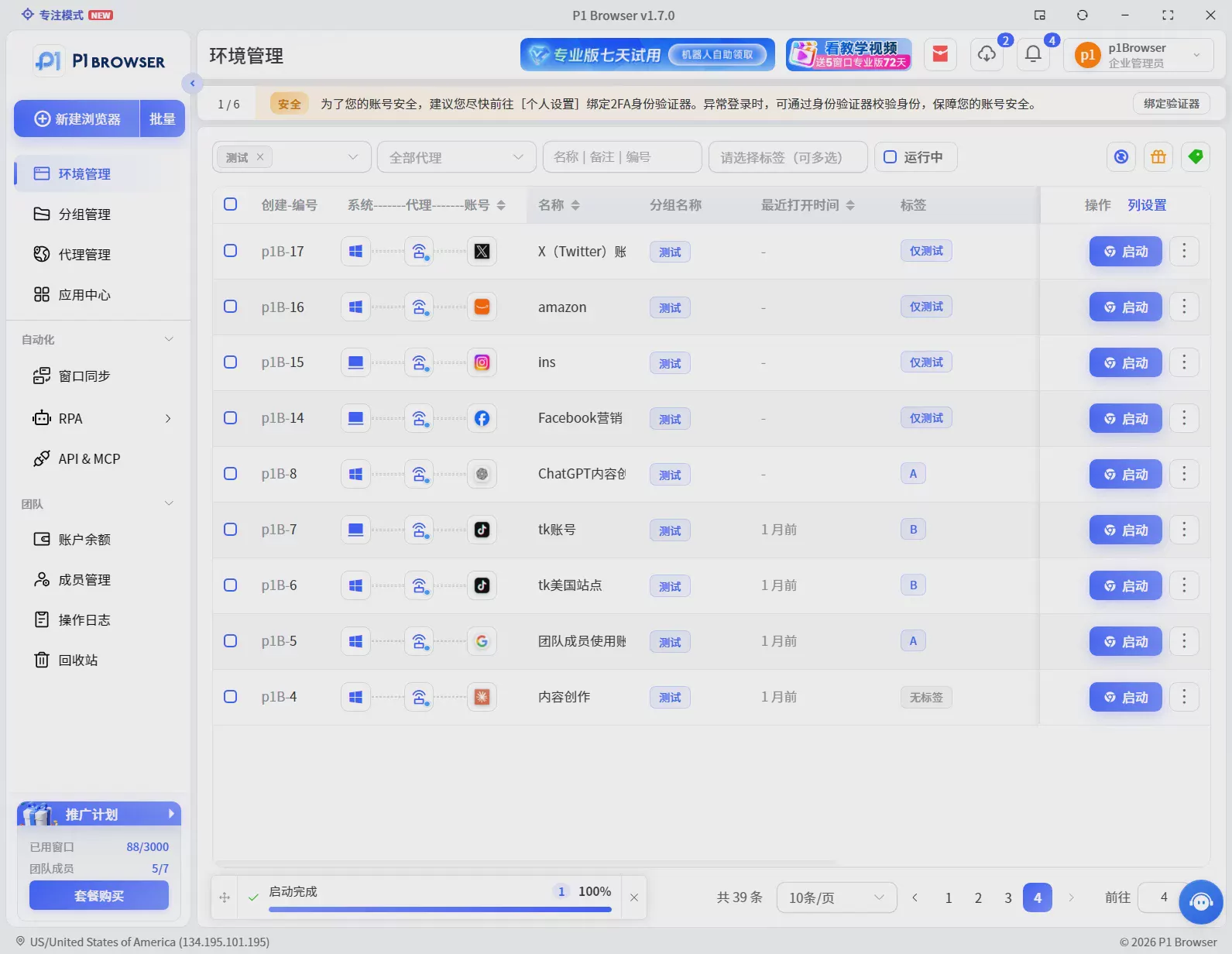
Summary
The biggest difference between a regular browser and a fingerprint browser is not the ability to open web pages, but the ability to manage the browser environment. A regular browser is suitable for single-user, few-account scenarios. However, when a business enters the stage of multiple accounts, multiple teams, and multiple environments, the browser itself becomes infrastructure that needs to be managed.
From Cookie isolation to browser Profile and then to more professional environment management solutions, the browser is gradually evolving from a simple access tool into an important operating environment that carries business identity.
Understanding this change is also the foundation for understanding the future development of multi-account operation tools.
Frequently Asked Questions FAQ
Does opening multiple windows in a regular browser count as environment isolation?
Not really. Multiple windows in a regular browser share the same set of cookies, cache, browser fingerprints, and device parameters. Platforms can use this shared data to identify that multiple accounts come from the same browser environment. True isolation requires each account to have independent data storage and environment parameters.
What is the difference between a fingerprint browser and running multiple instances of a regular browser?
Running multiple instances of a regular browser merely opens multiple windows in the interface, while the underlying data is still shared. Each environment in a fingerprint browser has independent cookies, browser fingerprints, device parameters, and network configurations, achieving isolation at the runtime environment level rather than simple window separation.
Are free fingerprint browsers sufficient?
Free plans usually allow you to create a small number of environments, which is suitable for personal testing. However, for scenarios that require long-term operation, team collaboration, and batch management, it is recommended to choose a more feature-complete paid plan, with attention to environment stability, management efficiency, and long-term usage costs.
Are fingerprint browsers safe?
A fingerprint browser is itself an environment management tool, and its security depends on the product's own data protection capabilities and how the user uses it. Reputable products typically store local environment data in encrypted form and do not upload users' private information. However, it should be noted that account security depends not only on the browser tool, but also on factors such as account management practices, network environment configuration, and compliance with platform rules. Using the tool properly and following platform rules are the foundation for ensuring long-term account stability.