


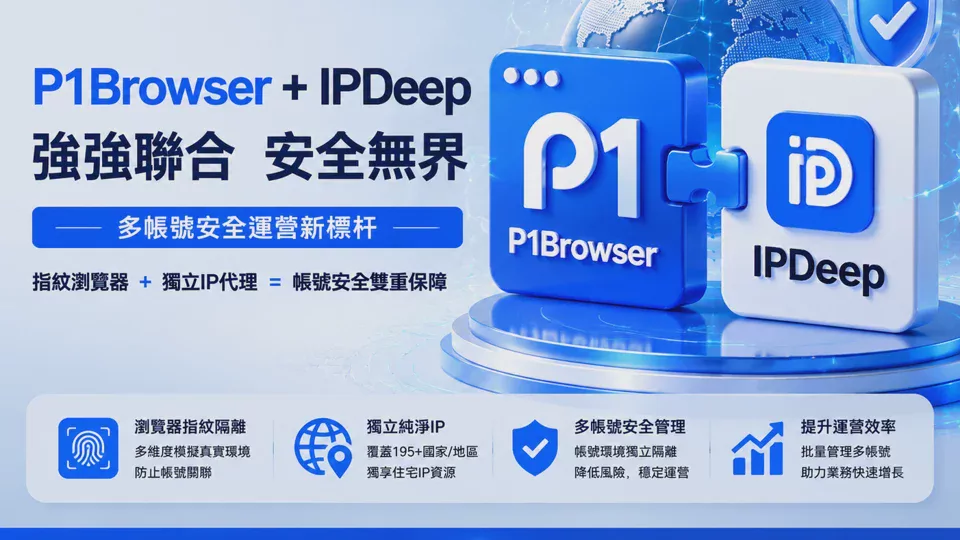
P1Browser+IPDeep Static Residential IP: A Practical Guide to Localized Overseas Social Media Operations
Multi-account management and matrix operations on overseas social media platforms are an important means for the current cross-border industry to acquire traffic and expand overseas markets. As platform security policies continue to escalate, network stability, environment consistency, and operational efficiency in multi-account management have become technical aspects of widespread concern among practitioners.
However, traditional methods such as clearing cookies and using browser incognito mode can no longer meet the needs of long-term, stable operations.
Modern platforms typically conduct a comprehensive analysis of IP attributes, browser environment characteristics, and operational behavior to evaluate the access environment.
ThroughIPDeep static residential IPandP1BrowserCombined with an environment isolation browser, it can build a more stable and compliant operating environment for overseas social media operations.
Network IP Selection in Localized Overseas Social Media Operations
When conducting multi-account or matrix operations, network IP is the first layer of basic information that platforms use to identify the source of access.
1. Differences in Attributes Between Data Center IPs and Residential IPs
Data Center IPs: They belong to the data center IP ranges of cloud service providers. They have high bandwidth and low cost, but because they are often used in scenarios such as bulk registration or data collection, they may have a higher risk weight in the trust assessments of some platforms. Logging in or performing operations with such IPs is more likely to trigger verification mechanisms.
Residential IPs: Civilian network addresses assigned by local broadband operators (ISPs) overseas to ordinary home users. Compared with some data center IPs, residential IPs are usually closer to the network access characteristics of ordinary home users and have more natural network attributes in certain business scenarios.
2. Applicable Scenarios for Static Residential IPs and Dynamic Residential IPs
Dynamic residential IPs: The outbound IP of such IPs changes according to the rotation policy of the proxy service provider. If the IP changes frequently within a short period, it will make network environment management very complex. They are more suitable for scenarios with low requirements for IP continuity, such as public data collection, price monitoring, or short-term testing.
Static residential IPs: They can maintain the same IP address for a long period, providing a more consistent access environment for long-term businesses that require a stable network exit (such as daily account maintenance, advertising placement, payment verification, etc.), and are one of the foundational safeguards for stable long-term cross-border operations.
3. IPDeep's Supporting Capabilities
IPDeep provides coverage across multiple countries and regions around the worldStatic Residential IP, with support for flexible selection of city, bandwidth, and other configurations based on the target market, providing overseas businesses of different scales with a network environment that better matches their actual needs.
With stable IP connections and high availability, IPDeep Static Residential IP helps users maintain a more consistent network access environment and provides reliable network support for long-term operations such as overseas social media management, advertising, and account management.
Browser Environment Consistency: Why Configuring an IP Alone Is Still Not Enough
Many operations staff still find that even after configuring high-quality IPs, account management is not smooth enough, or the environment gets flagged.
This is because modern social media platforms generally collect multiple characteristics from browser and device environments to generate browser fingerprints used to identify and associate access environments.
Even if no local Cookie is written, platforms can still read the device's comprehensive software and hardware environment characteristics through the web backend, forming a set of information used for tracking and identification.
1. Hardware-Level Environmental Characteristics
Canvas fingerprint: Web pages use HTML5 Canvas elements to draw hidden images; different devices' graphics cards, drivers, and rendering engines have slight differences, and the rendering result can serve as one of the characteristics of a browser fingerprint.
WebGL fingerprint: Collects the vendor, model, and 3D rendering parameters of the device's graphics card (GPU) as one of the fingerprint characteristics.
AudioContext fingerprint: By testing the software and hardware configurations of the audio module, it analyzes audio waveform differences and forms audio-related fingerprint characteristics.
2. Environment-Level Characteristics and Data Consistency
including the operating system's User-Agent, time zone, default language, and WebRTC-related configurations, etc.
If you log in using a US static IP, but the browser time zone still shows UTC plus eight (Beijing time), or the WebRTC configuration generates network information inconsistent with the proxy, this kind of environment inconsistency may be flagged as abnormal by the platform.
How do IPDeep static residential IPs work together with P1Browser?
When combining proxy IPs with a browser environment management tool, the specific key steps are as follows:
1. Prepare the environment and IP: InP1Browser, create a separate browser environment for each overseas social media account that needs to be managed.
Purchase and obtain a dedicated static residential IP for the corresponding target country (such as the United States, Japan, Hong Kong, China, etc.) in the IPDeep backend.
2. Bind the IP and synchronize parameters: Import the purchased static residential IP information (including host address, port, username and password) into the corresponding environment configuration file in P1Browser.
When using it, you can reasonably set the browser time zone, language, geolocation, WebRTC policy, and other parameters according to the region where the proxy IP is located, so that the environment information remains relatively consistent.
3. Follow operational guidelines: After the environment is set up, you should follow the platform's community guidelines and account usage policies during actual operations, and avoid abnormally high-frequency operations within a short period of time.
For new accounts, it is recommended to first engage in normal content browsing and light interaction, and gradually build up a normal activity record.
Application scenarios for localized operations
TikTok account operations and content distribution: Using static residential IPs to simulate the network environment of target regions and maintain a relatively stable network access egress helps with local content research and long-term operations.
Facebook & Instagram matrix management: Allocate independent browser environments and static residential IPs to different advertising accounts or daily management Pages, keeping each operating environment relatively independent and facilitating daily content management, ad testing, and multi-region business comparison.
WhatsApp & LinkedIn overseas traffic acquisition: For social platforms that require long-term login, a relatively stable network environment can reduce the additional operational costs caused by frequently changing access environments and improve the smoothness of daily communication.
Summary
In overseas expansion operations, the stability and consistency of the underlying network environment are an important part of ensuring operational efficiency.
The combination of IPDeep's highly anonymous static residential IPs and P1Browser's browser environment isolation feature can provide a more reliable network and environment foundation for localized operations on overseas social media, helping practitioners focus more on content creation, user interaction, and market expansion.
To obtain IPDeep's latest global static residential IP packages +P1Browser browser, please visit IPDeep official website for detailed information.