



As TikTok continues to grow globally, more and more creators, cross-border sellers, and brand teams are beginning to focus on one question: how much revenue can TikTok views actually bring?
When many people search for ways to make money on TikTok, they see similar questions: “How much does TikTok pay for 1000 views?”, “How much can you earn from one million TikTok views?”, “Can you really make money from TikTok views?”
Behind these questions is a trend of more and more users hoping to earn income through TikTok. In reality, however, TikTok revenue is not calculated simply based on the number of views, and there is no fixed formula that applies to all accounts.
Even for a video with 100 ten-thousand views, the final revenue earned by different accounts can still differ very significantly. Some videos have a large number of views but do not generate obvious income, while some videos with not particularly high view counts can achieve higher value through product sales, brand partnerships, or account commercialization.
The reason is that TikTok's commercial value does not depend solely on the number of views; it is influenced by multiple factors, including video content quality, the region where viewers are located, user interaction, account operation status, and subsequent commercial conversion capability.
For ordinary creators, understanding TikTok's revenue mechanism can help them formulate more reasonable content operation strategies; for cross-border sellers and corporate teams, it is more important to understand the account operation logic behind TikTok, establish a stable account system, and move from traffic acquisition further toward commercial conversion.
This article will help you comprehensively understand the 2026 TikTok revenue model from aspects such as TikTok view revenue calculation methods, key factors affecting income, main monetization methods, and multi-account operation management.
I. Why Can't TikTok Views Directly Equal Revenue?
Many users who have just started operating TikTok accounts simply equate views with income, believing that as long as a video receives enough views, it will generate corresponding revenue.
This understanding is not entirely accurate.
TikTok views are only an indicator of content distribution effectiveness; they do not mean that every view generates direct revenue. The platform usually makes a comprehensive assessment based on multiple factors, such as whether a video meets the requirements of its monetization program, the quality of viewing users, content performance, and advertising value.
Simply put, one million views do not equal a fixed amount of income.
For example, if two videos both have 100 ten-thousand views, and one of them is mainly watched by users in high-ad-value regions, with longer watch time and higher interaction rates, it may generate higher commercial value. Although the other video has the same number of views, its users may have shorter dwell time and lower interaction, so its final revenue may be completely different.
This is also why many creators notice a phenomenon: some accounts have very high video views, but their income is not as much as expected; while some vertical niche accounts, even if their views do not reach the million-view level, can still earn higher revenue through a precise user group.
What TikTok Really Focuses On Is “Effective Traffic Value”
On short-video platforms, views are only a traffic entry point, not the ultimate value.
TikTok pays more attention to how users interact with content. For example, whether a user watches the video in full, likes or comments, follows the account, or further clicks on a product or profile link—these behaviors all affect the commercial value of the content.
For platforms, high-quality content can bring longer user dwell time and can also enhance the value of ad impressions. Therefore, a video account that can consistently attract user attention usually has greater long-term value than an account that relies solely on the occasional viral hit to gain a large number of views.
This is also why many mature creators do not focus only on "how many views today's video got," but instead pay attention to overall account data changes, including follower growth trends, user profiles, and whether the content direction is stable.
Views are just the beginning; account value is what determines long-term returns
If TikTok operations are viewed as a complete business system, then views are only the first step.
For individual creators, views can help an account gain exposure; for cross-border brands, views can help products enter consumers' field of vision. But whether revenue can ultimately be generated still depends on whether the account has the capability for sustained operations.
For example, a TikTok account with a stable follower base can continuously generate commercial value through product recommendations, TikTok Shop, brand partnerships, and other methods.
In contrast, an account with only a single viral video and no ability to consistently produce content will find it difficult to generate long-term returns, even if it gains a large amount of traffic in the short term.
II. What Are the Main Revenue Sources for TikTok in 2026?
Many users search for "how much does TikTok pay per view," when what they are actually interested in is how TikTok creators earn income through the platform.
However, as TikTok's commercial ecosystem continues to improve, the ways in which creators and businesses generate revenue are no longer limited to simple view-based rewards.
Based on current operational trends, TikTok revenue sources mainly include platform rewards, product sales, affiliate marketing, brand partnerships, and several other directions.
TikTok Creator Rewards Program
The creator revenue program launched by TikTok provides eligible creators with the opportunity to earn income through their content.
However, many newcomers easily misunderstand this mechanism, assuming that as long as a video gets a large number of views, they will definitely receive corresponding income.
In reality, the platform usually takes into comprehensive consideration factors such as video quality, valid views, user engagement, and the region where the account is located.
Therefore, if creators hope to earn stable income through TikTok, they need to focus not only on the number of views, but also on how to consistently produce content that meets the needs of the platform's users.
TikTok Shop sales revenue has become an important direction for cross-border sellers
For cross-border sellers, earning revenue solely from TikTok views is not the primary business model. Rather than waiting for the platform to distribute revenue, more and more brands and merchants are beginning to use TikTok content to directly drive product sales.
This is also one of the important reasons for the rapid development of TikTok Shop in recent years.
Through short videos, live streams, and influencer collaborations, sellers can directly convert content traffic into product orders. While watching videos, if users become interested in a product, they can directly enter the product page to complete the purchase.
This model has changed the way traditional e-commerce relies on search traffic to obtain orders, making content itself a new sales entry point.
For example, a beauty brand in the past might have needed to rely on search ads to acquire consumers, but now it can use TikTok videos to demonstrate product usage results, prompting users to develop purchase needs while watching the content.
For cross-border businesses, TikTok's value is no longer just that of a traffic platform; it is gradually becoming an important channel connecting content, users, and transactions.
Affiliate marketing helps creators monetize content
In addition to selling their own products, many TikTok creators also earn income through affiliate marketing.
This approach does not require creators to have their own products; instead, they recommend products from other brands and earn a commission after users complete a purchase.
For accounts with a highly targeted follower base, affiliate marketing is often more stable than relying solely on revenue from views.
For example, a TikTok account focused on outdoor gear can recommend relevant products through review videos; an account focused on tech products can introduce electronic devices through hands-on experience.
When content is highly aligned with user needs, even an account without a particularly large follower count may generate solid commercial value.
Brand partnerships are an important revenue source for mature accounts
Once a TikTok account has established stable influence, brand partnerships also become an important source of income.
Many businesses hope to reach their target user groups through TikTok influencers, so they choose to collaborate with creators in specific verticals.
Compared with traditional advertising, influencer content is usually more natural, because users see the creator's genuine experience rather than a straightforward product promotion.
However, brand partnerships place higher demands on account quality. Brands typically pay attention to the account's follower demographics, content quality, engagement data, and long-term stability.
Therefore, a TikTok account with real commercial value needs to accumulate content assets over the long term, rather than only chasing short-term viral hits.
III. What factors determine TikTok view earnings?
Many users, when learning about TikTok earnings, will discover a question: Why do different accounts show such obvious differences in data performance?
Even for the same popular video, some accounts can earn decent revenue, while others see no obvious change.
This is mainly because TikTok earnings are affected by multiple factors together.
The region where users are located affects the account's commercial value.
TikTok is a global platform, and users in different regions have different commercial value.
For example, mature markets such as the United States, the United Kingdom, and Canada usually have higher advertising value and spending power, so user traffic from these regions often has higher commercial potential.
While some markets can bring in a large number of views, due to differences in the advertising market and spending power, the final revenue generated may vary.
This is also why many cross-border teams, when operating TikTok accounts, position their accounts according to the target market, rather than simply pursuing global traffic.
Watch time and user interaction are more important than mere view counts.
The core competitiveness of short video platforms is user retention time.
If a video receives a large number of clicks but users leave quickly, the platform will consider the content to have limited value.
Conversely, a video that can get users to watch it in full, actively comment, like, and even share it is more likely to continue receiving recommendations.
Therefore, excellent TikTok operations teams usually focus on analyzing:
- Average user watch time
- Video completion rate
- Comment engagement
- User follow conversion rate
These data are more valuable for reference than simply looking at the number of views.
The content niche determines commercial conversion potential
Different content directions also show significant differences in commercial value.
For example, entertainment content may be more likely to gain a large amount of exposure, but users' purchase intent may be relatively weak.
Meanwhile, some vertical niche content, such as tech products, beauty, healthy living, and tool products, may not achieve as high a view count as entertainment content in some videos, but its users may have stronger commercial value.
For cross-border sellers, choosing a content direction that suits their own products is more important than simply chasing trending topics.
Account operation stability affects long-term revenue
The value of a TikTok account is not determined by any single video, but is built through long-term operation.
An account that consistently produces high-quality content and has a stable user base is more likely to gain business opportunities.
Conversely, if an account frequently changes its content direction and constantly modifies its operation strategy over the long term, it may lead to a confused user profile and affect subsequent growth.
Therefore, whether you are an individual creator or a corporate team, you need to establish a long-term account operation plan.
四、Why is there such a huge gap in account revenue despite the same view count?
Many newcomers to TikTok discover a seemingly contradictory phenomenon:
Some accounts have very high video view counts but less-than-ideal income; some accounts have not reached million-level view counts, yet can continuously generate revenue.
The core reason for this difference is that the business models behind the accounts are different.
The difference between traffic accounts and business accounts
An account that purely pursues view counts pays more attention to whether the content is easy to spread.
For example, funny content, trending content, and entertainment content may quickly gain a large amount of exposure.
But if this traffic cannot be converted into user trust, product sales, or brand value, then its long-term commercial value is limited.
Commercial accounts, by contrast, usually operate around clear objectives.
For example:
A cross-border brand account will create content around product features; a tool-type account will provide solutions around user pain points.
These accounts may not grow as quickly as entertainment accounts, but their user value is more stable.
Account positioning determines future growth potential.
TikTok operations are not simply about posting videos; they are about building a long-term asset.
If account positioning is clear, the platform can more easily identify the user group, and brands can more easily assess the value of collaboration.
Therefore, for teams that want to develop through TikTok over the long term, account positioning and operations strategy are more important than short-term view counts.
Five. New Challenges Facing Cross-Border Teams Operating TikTok Accounts
For individual creators, operating a TikTok account may only require focusing on content creation and data performance. But for cross-border businesses, TikTok operations are gradually becoming a more complex systems engineering effort.
As brands enter more overseas markets, companies usually do not operate just one account; instead, they establish multiple account systems based on different countries, different products, and different marketing goals.
For example, a cross-border brand may simultaneously operate a U.S. market account, a European market account, a product showcase account, an influencer collaboration account, and an ad placement account.
This matrix-based operating approach can help companies reach more users, but it also brings challenges in account management.
From single-account operation to multi-account management, companies need to face more issues
Many companies may have only one account when they first start operating on TikTok, with one operations person responsible for all the work.
This model does not present obvious problems when the number of accounts is relatively small.
But as the business expands, companies need to maintain multiple accounts at the same time, with different accounts taking on different responsibilities, and management difficulty increases rapidly.
For example:
The U.S. market account is mainly responsible for product promotion, the U.K. market account is responsible for localized content operations, and another account may be dedicated to influencer collaboration or testing different content directions.
Without a reasonable management approach, operations staff can easily encounter situations such as account mix-ups, operational errors, and disorganized data records.
Switching between multiple accounts increases daily operating costs
When many teams manage multiple TikTok accounts, the most common problem is frequent logging in and switching.
Traditional browsers usually use the same browsing environment, making it easy for different accounts to become associated.
When operations staff need to manage multiple accounts every day, they have to constantly log out, log back in, or repeatedly confirm which account they are currently using.
In the long run, this repetitive work not only reduces efficiency but also increases the difficulty of team management.
For enterprises that need to operate overseas accounts at scale, the more important question is not “whether they can log in to accounts” but how to establish a clear, orderly account management process.
Team collaboration makes account management more complex
Operating TikTok for a business is usually not a one-person job.
Content teams handle video production, operations teams handle account maintenance, advertising teams handle promotion, and data teams handle performance analysis.
Different people need to participate in account management, so enterprises need to address issues such as permission allocation, account records, and work handovers.
If all accounts are maintained relying on personal browsers and personal habits, management chaos can easily arise when personnel change or the business expands.
Accounts for different markets require more refined operations
One of TikTok's biggest characteristics is that user habits differ significantly across regions.
A video that performs well in the US market is not necessarily suitable for the European or Asian markets.
Therefore, more and more companies are beginning to set up separate accounts for different regions and use localized content to improve user connection.
At the same time, however, an increase in the number of accounts also means that companies need more standardized management approaches.
Six. How can you build a long-term, stable TikTok account operation system?
To achieve sustained growth through TikTok, companies need to focus not just on the data performance of a single video, but on building a complete account operation system.
A mature TikTok operation process usually includes multiple stages, such as account planning, content strategy, data analysis, and account management.
Clarify your account positioning and avoid a muddled content direction
Many accounts struggle to grow not because their content quality is poor, but because their account positioning is not clear enough.
If an account publishes a product introduction today, entertainment content tomorrow, and videos from a completely different field the day after, it is hard for both the platform and users to judge the account's value.
For corporate accounts, it is even more important to clarify in advance:
Which market does this account serve? Who are the target users? What goals do you hope to achieve through content?
For example, a cross-border brand account can continuously produce content around product use scenarios, user pain points, and brand stories.
A long-term, stable content direction helps build a more precise user group.
Continuously optimize content instead of relying on occasional viral hits
Competition for TikTok content is becoming increasingly fierce, and it is difficult to achieve long-term growth with just one viral video.
Truly mature operations teams will identify the direction suitable for account growth by continuously testing different content formats.
For example, test:
Different video openings, different presentation methods, different user scenarios, and different content lengths.
Continuously adjust content strategy based on data feedback rather than relying on experience-based judgment.
Focus on the user value behind the data
Views are the most visible metric, but they are not the only important indicator.
Businesses should pay more attention to:
Are users willing to stay? Do they engage? Do they learn more about the product? Do they ultimately make a purchase?
This data can help businesses determine whether an account truly has commercial value.
Establish standardized account management practices
As the number of accounts increases, businesses must shift from individual operation to team-based management.
This means establishing clearer account management processes.
For example:
Accounts for different markets are managed separately, accounts for different businesses are categorized and stored, and team members access the corresponding environments according to their responsibilities.
Only by establishing standardized processes can businesses maintain operational efficiency while scaling.
Seven, how does P1 Fingerprint Browser help businesses manage TikTok accounts?
For cross-border businesses currently engaged in TikTok matrix operations, account management efficiency has become an important factor affecting long-term development.
When a business grows from one account to multiple markets, multiple product lines, and multi-team collaboration, traditional browser environments often find it difficult to meet complex operational needs.
By creating independent browser environments, P1 Fingerprint Browser helps businesses manage different TikTok accounts more clearly, enabling teams to establish a more standardized account operation system according to business needs.
Establish independent operating environments for different TikTok accounts
For example, a business operates multiple overseas market accounts at the same time: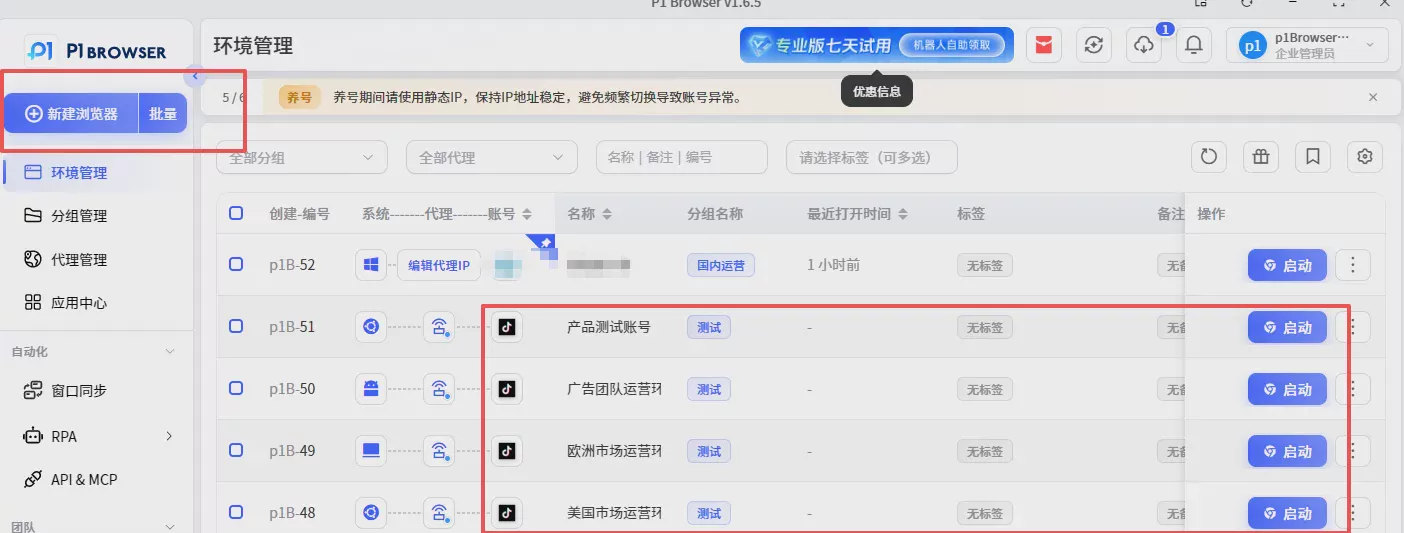
Each account has an independent browsing environment, and operators can access the corresponding environment for management based on business needs.
This reduces the confusion caused by frequently switching between multiple accounts and improves daily operational efficiency.
Help teams with multi-account collaborative management
For enterprise teams, account management is not just a technical issue but also a process issue.
P1 can help teams establish clear browser environments based on different business lines, allowing different members to be responsible for the corresponding accounts.
For example:
The content team is responsible for the content operations environment, the advertising team is responsible for the promotion account environment, and the marketing team is responsible for managing accounts in different regions.
Through a clearer division of labor, enterprises can reduce communication costs during multi-person collaboration.
Support long-term overseas business expansion for enterprises
TikTok is becoming an increasingly important growth channel for cross-border brands.
As enterprises enter more markets, the number of accounts and operational complexity will continue to increase.
Therefore, establishing a stable account management approach in advance can help businesses better respond to future growth needs.
P1指纹浏览器 does not simply solve a single login issue; rather, it helps businesses build a more systematic environment for overseas account operations, enabling teams to focus more on content growth, user operations, and commercial conversion.