


Beginners assume that product selection on all three platforms is just "check sales volume, find blue oceans," but the decision chains start from completely different points. Amazon works backward from search keywords to identify demand, TikTok works backward from content assets to predict impulse buying, and Temu works backward from the platform's target procurement price to assess supply-chain capability. Using the wrong decision chain costs more than picking the wrong product—two weeks of Amazon BSR research you carry over to TikTok simply cannot guide product selection, because the information-flow mechanisms that trigger purchase behavior on the two platforms are fundamentally different.
The Essence of Product Selection Logic: Three Decision Chains, Not a Single Selection Sheet
Most product selection tutorials cram three platforms into the same Excel scoring sheet, which is a methodological error in itself. The inputs, intermediate variables, and output endpoints of the three chains are all different—no universal scoring table exists. Applying Amazon's "search volume–competition" model to TikTok means you will systematically overlook the core variable of "whether this content can trigger a purchase impulse in a scrolling viewer within 3 seconds." Porting Temu's "procurement price–gross margin" logic to Amazon means you will underestimate the rigid constraint that FBA storage and delivery costs impose on final pricing.
The cost of using the wrong chain is not simply "picking a suboptimal product"—it is that your entire research workflow, supplier negotiation scripts, and pricing strategy all need to be torn down and rebuilt. A person who has successfully executed the "core keyword → competitor review gap → FBA logistics" pipeline on Amazon, if they plug the same SOP directly into TikTok, will most likely hit a wall at the step of "whether the content asset possesses a replicable hook," because TikTok's starting point for product selection is not search intent at all—it is visual impact and emotional trigger.
A Detailed Breakdown of the Three Decision Chains
The Amazon Chain (Reverse-Engineering from Search Intent):
- Core search keyword confirmation:Use Brand Analytics or Helium 10 to lock in the head terms and long-tail keywords for your target category. The inputs are keyword search volume and click share data.
- BSR trend assessment:Monitor ranking fluctuations of the Top 10 ASINs under the target keyword. The input is at least 8 weeks of BSR historical curves to determine whether the category is in a growth or decline phase.
- Review gap identification:Read 1-3 star reviews of competing products to pinpoint unmet functional or experience pain points. The input is 50 or more valid review texts.
- Logistics model validation:Calculate the landed gross margin after FBA first-mile freight + storage + delivery + commission. The inputs are product dimensions and weight, target selling price, and Amazon's fee schedule. Amazon officially remindsthat cross-associations between multiple selling accounts may exist, so when selecting products, consider whether independent accounts need to be opened in different regions or categories.
TikTok chain (reverse-engineering from content momentum):
- Asset feasibility test:Use a 15-second live-action product video to determine whether the content itself has enough stopping power to hold viewers before they swipe away. The input is whether the product's appearance possesses visual hooks (color contrast, before-and-after difference, operational surprise).
- Creator ecosystem scan:Review the existing creator collaboration volume and organic traffic ratio in the same category to determine whether the category has passed the "creator sales saturation point." The input is the number of TikTok Shop creator sales videos and average views for this category over the last 30 days.
- Impulse trigger identification:TikTok's purchase decision cycle is extremely short; product selection must clearly convey "why I need to buy it right now" within a single screen. The input is the product unit price (conversion rates are typically highest below $15) and the emotional intensity of the use scenario.
- Return rate estimation:The return rate driven by impulse spending is a cost node unique to the TikTok chain. The input is the historical return rate for the same category (apparel generally has higher rates than functional products), which directly impacts actual gross profit.
Temu chain (platform pricing back-calculation):
- Platform target procurement price:The starting point for product selection on Temu is the target supply price set by the platform, not the price you want to sell at. The input is the category target price range on the Temu backend or recruitment page.
- Category gross profit line calculation:Work backward from your target supply price to calculate the remaining margin after factory cost + packaging + domestic logistics. Inputs: supplier quotes and packaging material costs.
- Supply chain batch capacity:Temu requires stable batch supply. Product selection must fall within SKUs you can consistently deliver at the target price. Inputs: factory monthly production capacity and stock-up cycle.
- Platform price-comparison logic:Temu is a cross-market price-comparison platform. Once your supply price exceeds that of comparable competitors, you will face price pressure or delisting. Inputs: current supply prices and sales rankings of identical competing products.
Which chain your resources align with
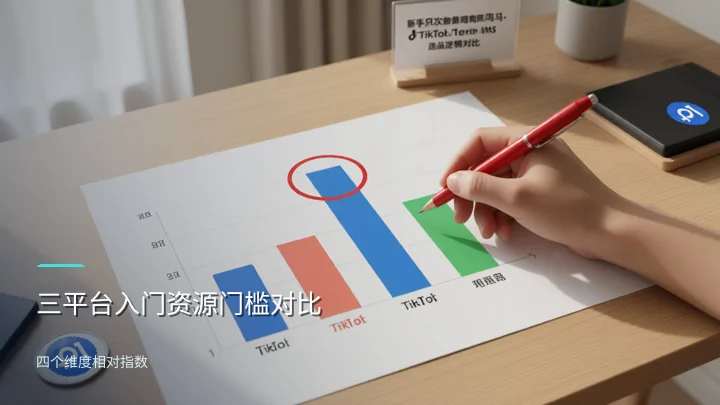
The chart above shows the relative index of entry-level resource thresholds for the three platforms across four resource dimensions (1-10, higher means more demanding; illustrative relative indicator, not actual statistics). How to read: look horizontally to see the resource requirement distribution for a given chain; look vertically to compare differences among the three platforms within the same dimension.
If your supply chain depth is weak but your content production capability is decent, the TikTok chain is a better starting point—shoot a product-in-use scenario video with 300 yuan to test market reaction, then decide whether to stock up after validating demand. Conversely, if you have factory resources but can't produce content, the Temu chain's “platform price comparison–batch supply” model is a better fit: you don't need to create content, just keep your supply price within the platform's target line. The Amazon chain has the highest combined requirements for capital and supply chain, making it suitable for beginners who already have 1688 or factory relationships and can tolerate a 4-6 week stock-up cycle.
Under multi-store operations, product selection strategy shifts from single-item to matrix
In the single-store stage, your goal is to “find one product that can win.” Once you move into multi-store operations, the product selection logic immediately shifts: multiple stores on the same platform cannot use homogenized product selection, or you will trigger the platform's associated-account detection and cause internal traffic cannibalization among your own stores. Amazon's official policy clearly states that typically only one account should be operated per region; multiple accounts are permitted only when there is a legitimate business need, and a policy violation on one account can affect associated accounts.
On the operational level, multi-store setups on the same platform should be segmented by category (e.g., Store A handles small home appliances, Store B handles outdoor sports accessories), while cross-platform multi-store setups must select products based on each platform's decision chain—you cannot take Amazon's BSR data and directly list on Temu, nor can you simply move a TikTok viral product to Amazon for search traffic.
Execution path for the first month (based on your chosen decision chain)
Amazon chain:
- Week 1:Select 1 category, use free keyword tools to pull the Top 50 search terms and monthly search volume for that category, then filter out 3 long-tail keywords where "search volume >1000 and top ASIN review count <500" as entry points.
- Week 2:Conduct a review gap analysis on competitors under the 3 entry keywords—read at least 50 1-3-star reviews for each keyword and summarize actionable product improvement points.
- Week 3:Take the improvement points to 1688 or a factory for prototyping, while simultaneously calculating FBA landed cost (first-mile + storage + fulfillment + commission). Confirm gross margin ≥30% before moving to the next step.
- Week 4:Ship the first batch of 50-100 units to FBA. In the first 14 days after listing, focus on A+ content pages and keyword coverage—do not scale up advertising.
TikTok chain:
- Week 1:Identify 1 product under $15, shoot 3 15-second videos with different hooks (using before-and-after comparisons, unboxing surprises, and scenario-based content), then post them on your own TikTok Shop account to test organic traffic.
- Week 2:Filter content directions with plays >1000 and conversion rate >1%, use that direction to find 5-10 creators with 1万-10万 followers for sample-sending collaborations, and compare the GMV share between organic traffic and creator traffic.
- Week 3:Based on creator data, confirm the main push SKU, activate the TikTok Shop multi-store feature, and prepare the account architecture for future product expansion and matrix division of labor. For specific multi-store management methods, seeTikTok Shop Multi-Store and Multi-Account Operations Guide.
- Week 4:Maintain 2-3 video posts per day, set up a return rate monitoring sheet (target return rate <15%), and immediately investigate the gap between product descriptions and actual user experience when the threshold is exceeded.
Temu route:
- Week 1:Complete the preparation of onboarding documents such as your business license, legal representative's ID, and receiving account. Follow theTemu Registration Process Breakdown and Anti-Ban Document Preparation Checklistitem by item to avoid repeated submissions after an audit rejection.
- Week 2:Once your onboarding is approved, check the platform purchase price range for your target categories in the Temu seller dashboard, and identify the 3-5 SKUs you can supply stably at that price point.
- Week 3:Complete the first batch of shipment fulfillment, confirm packaging specifications and logistics delivery times simultaneously, and record the deviation between your actual supply price and the platform's target price.
- Week 4:Track the price-comparison ranking changes for your first batch of orders. If competing products in the same category are undercutting your prices, immediately activate your backup SKU replacements and keep your live SKUs in the store at ≥10.
FAQ
Can I work on all three platforms at the same time? Will product selection conflict?
You can work on all three, but product selection must be executed independently along each platform's decision chain. Amazon relies on search intent, TikTok on content momentum, and Temu on platform purchase prices—the input data across all three chains has zero overlap. The only real conflict is your bandwidth: a beginner pushing all three chains simultaneously will fail to maintain the "Week 2 validation – Week 3 iteration" cadence on any of them. It is recommended to concentrate your resources on getting one chain running end-to-end first, then open the second one in the second month.
Which chain should beginners with weak supply chain capabilities avoid?
Avoid the Temu chain. Temu's core competitive dimensions are supply pricing and batch stability. Without a direct factory relationship or deep supplier connections, your gross margin will be squeezed to near zero by the platform's price-comparison mechanism. The TikTok chain has the lowest requirement for supply chain depth—a 300 yuan sample is enough to kick off testing, making it ideal for asset-light beginners.
After product selection, when should you switch platforms?
The criterion is not 'this product isn't selling' but rather 'the core assumption behind this decision chain no longer holds.' For example, the TikTok chain's core assumption is that 'content can trigger impulse buying.' If 4 consecutive hook videos with different hooks all get organic views of <500, it means the category lacks content momentum in TikTok's feed. At that point, switching products is less effective than switching platforms—match your supply chain advantage to the Temu or Amazon chain and find a new entry point.