



At two in the morning, Operator A finished updating the proxy settings in the Temu dashboard but did not switch browser Profiles—she opened Amazon Seller Central directly in the same Profile. The next morning, both platforms triggered a "new environment login" risk-control alert simultaneously—Temu froze the store funds, and Amazon requested additional identity verification. It was not that both platforms were glitching at the same time; it was the same browser environment that mixed the Cookies, device parameters, and IP changes from both operations together.
Contact Surface: The Real Logic Behind Multi-Account Association
Account A being independently secure and Account B being independently secure does not mean there are no shared variables between A and B. The so-called contact surface refers to the IP, Cookie, device fingerprint, login time window, and operational behaviors shared by two accounts on the same device. Platform risk control does not only check whether this account itself has violations; it also detects whether this account's environment overlaps with known accounts.
Amazon's official guidance on multiple accounts states: when there is a legitimate business need, you can operate multiple accounts, but a policy issue on one account may affect associated accounts (Amazon Seller Forum: Multi-Selling Account Health Notice). In other words, if isolation is insufficient, a problem on one store will drag other stores down through environmental association. TikTok's Business Center tracks each account's access source through member operation logs, and unauthorized sharing of login credentials alone will trigger anomaly flags (TikTok Business Center Roles and Permissions Guide).
Comparison of Detection Dimensions Across Three Platforms
Managing three platforms on a single computer is fundamentally different in risk structure from managing one account on each of three separate platforms. The table below lists the core dimensions of account-association detection across the three platforms for easy cross-checking:
| Detection Dimension | Amazon | TikTok Shop | Temu |
|---|---|---|---|
| Network Layer | Multiple accounts in the same region require different IP ranges; IP range reuse will be flagged. | Proxy IPs must match the store's operating region; Business Center logs the source IP. | IP consistency is checked after proxy switching; the network region must align with legal-entity information. |
| Device Layer | Browser fingerprint, hardware ID, system language | Browser profile isolation and device parameter consistency verification | Cross-referencing of device parameters and registration credentials |
| Behavior layer | Login frequency, bulk operation rhythm | Operation time distribution, member operation logs | Time gap between registration and operations, bulk behavior patterns |
| Credentials layer | Multiple accounts under the same entity require justification of legitimate business needs | Consistency between business license and legal representative information | Legal representative information consistency, payment account and entity matching |
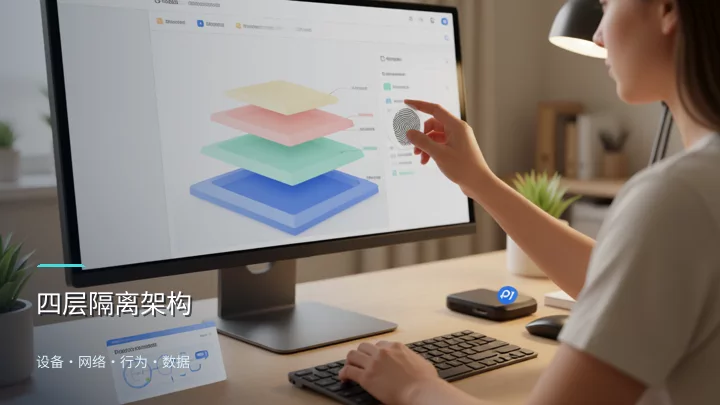
Key points for four-layer isolation configuration
Bringing the table above down to the operational level, isolation is divided into four layers. Each layer corresponds to different tools and actions; skipping any one layer will render the protection of the other three layers ineffective.
- Device layer — fingerprint browser Profile isolation.Each account corresponds to a dedicated Profile, and device parameters (Canvas, WebGL, fonts, screen resolution) are generated within that Profile and are never shared across Profiles. For configuration steps, refer directly to theFingerprint Browser Environment Isolation and Proxy Configuration Guide. Special note for Temu: legal entity information must be consistent with the network region bound to the Profile; otherwise, the qualification-layer check will be triggered.
- Network layer — proxy IP must match the platform region.Allocate at least one dedicated IP range per platform. The proxy for Amazon US cannot simultaneously serve Temu US account sessions. The proxy region for TikTok Shop must match the store's operating location. After switching proxies, wait at least 24 hours before performing any backend operations to avoid overlapping time windows.
- Behavior layer — differentiated operation rhythm.Login times and operation frequencies across accounts should not be uniform. In a team of three managing five accounts, each person's daily operation intervals should be randomized (ranging from 30 minutes to 2 hours) to prevent batch behavioral patterns from being flagged as bot activity or matrix accounts.
- Data layer — zero sharing of Cookies, cache, and local storage.Clear the temporary cache of the current Profile before switching to another Profile. Do not log into seller dashboards for different platforms within the same Profile. TikTok Business Center requires the use of official role-based authorization to manage access; sharing login credentials is prohibited.

The real association risk in team collaboration
The most common association incidents in multi-account operations stem not from technical vulnerabilities but from human operational inertia. They specifically manifest in three ways: sharing a Chrome Profile for both daily browsing and platform operations, logging into a dashboard after switching proxies without verifying the current environment, and pasting Account A's device configuration into Account B when copying device parameters. All three of these occur weekly in a five-person team.
The principle of least privilege boils down to one rule:One person, one Profile; one Profile, one proxy; mandatory verification of the current environment before every operation.It is not about trust; it is about process checkpoints. The role system in TikTok Business Center (Administrator, Standard Member, Finance) naturally supports assigning permissions by role, preventing the entire team from sharing a single high-privilege account (TikTok Roles and Permissions Documentation. For cross-platform collaboration, it is recommended to document the permission matrix in a shared team document. New hires should be granted read-only access during their first week, with write permissions gradually released after two weeks of operation. For a complete team permission management framework, refer toThe Five Key Steps of Account Matrix Management.
Minimum viable configuration for three people managing five stores
- Profile allocation:5 accounts map to 5 independent Profiles. Naming convention: "Platform-Region-Sequence" (e.g., AMZ-US-01, TTK-US-02, TEMU-US-03). Record this on the first page of the team document. Unauthorized creation of new Profiles is prohibited.
- Proxy allocation:Each platform requires at least 1 dedicated IP range. Each of the three team members holds 2-3 proxy nodes. Mark IP ranges in the proxy vendor's admin panel, mapping them one-to-one to Profile IDs.
- 30-second pre-operation check daily:Open the target Profile → confirm the current proxy IP address is correct → confirm the browser's time and time zone match the platform's region → then log in to the backend. Do not access the backend until all four steps are complete.
- New hire onboarding permission workflow:Weeks 1-2: read-only access + operation log review. Week 3: write access on designated platforms. From Week 4 onward: account management rights allocated based on actual workload. On the separation date, all Profiles and proxy nodes are reclaimed; no 7-day buffer is provided.
If the team scales from a single store to a multi-store setup, TikTok Shop's multi-account environment configuration includes a dedicated isolation checklist. It is recommended to cross-check againstthe TikTok Shop multi-account browser isolation planitem by item. For Temu multi-store compliance pathways and anti-association configuration, refer toCompliance Pathways and Risk Management for Multi-Account Temu Operations.
Frequently Asked Questions
Can you log into both Amazon and Temu seller dashboards on the same computer?
Yes, but you must operate within two separate Profiles, and the two Profiles must use different proxy IPs. Logging into both platforms sequentially within the same Profile will cause cross-contamination of Cookies and cache, triggering environment anomaly detection on both platforms.
Proxy IP costs are too high — can the three platforms share one proxy?
Not recommended. Sharing a proxy means accounts across three platforms share the same network egress. Once that IP is flagged by one platform, accounts on the other platforms will be affected as well. At minimum, split IP ranges by platform; when the budget is limited, allocate using the principle of "dedicated IPs for high-risk platforms + shared IPs for low-risk platforms."
Do accounts that a departing operator managed need to be reconfigured after they leave?
Yes. If a Profile operated by the departing employee has any abnormal login records, it is recommended to regenerate device parameters for that Profile and switch to a new proxy node, rather than handing it off directly to the next person. The handover cycle should include a 48-hour observation period to confirm that no secondary risk-control alerts are triggered by the platform.
Are the "association" criteria the same for Amazon, TikTok, and Temu?
No. Amazon focuses on entity qualifications and IP range reuse; TikTok focuses on Business Center operation logs and device consistency; Temu focuses on cross-verification of legal entity information and network region. The same isolation setup cannot be directly applied across all three platforms — at minimum, the network layer and behavior layer need to be adjusted separately for each platform.