

A team's 4th Vietnamese local store received a secondary review notice 72 hours after going live. Investigation revealed that logistics violation records from their 2nd Thai store had left cross-store Cookies and operation trails in the same browser Profile. This is not a problem solvable by simply 'opening a few more windows'—any shared layer among the four variables (network exit, device fingerprint, identity documents, and operation trails) can trigger the platform's multi-store association detection. The following provides an actionable configuration, from registration credentials to group permissions, for the scenario of running 4-6 Southeast Asian local stores on a single physical machine.
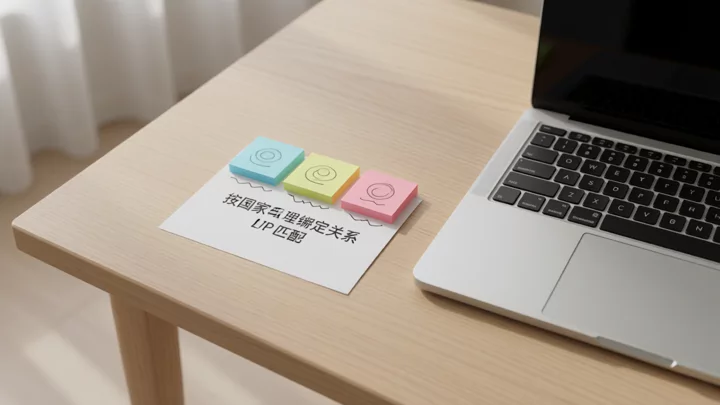
Registration Differences Between Local Stores and Cross-Border Stores: How Many Stores Can One Business License Support?
Southeast Asian local stores and cross-border stores differ fundamentally in their credential structures, which directly determines the upper limit of 'how many stores one license can support' and the source of secondary review risk. Local stores require a local legal entity, while cross-border stores accept a Chinese business license—the two follow entirely different review pipelines on the platform's backend. When document review fails, prioritize checking three items: license validity period, whether the registered address matches the address entered on the platform, and whether the industry category is restricted.
| Dimension | Southeast Asian Local Store (TH/VN/MY) | Cross-Border Store (CN Entity) |
|---|---|---|
| Business License Country | Must be a local legal entity (e.g., BD in Thailand, MSTS in Vietnam) | A Chinese business license is sufficient |
| Maximum stores per single certificate | Typically 1–3 stores (varies by country; refer to the platform dashboard for details) | Quantity limits are relatively lenient; specific quotas are subject to policy adjustments |
| Legal entity verification methods | Local government-issued ID + corporate bank account; some countries require a video-based in-person verification | Legal representative's ID + corporate bank account |
| Payout account | Must be a local bank or a licensed payment institution, with a one-to-one correspondence to each store | Cross-border payouts supported (Payoneer, LianLian Pay, etc.) |
| Common reasons for review rejection | License address mismatch, industry category not on the whitelist, legal representative verification timeout | License expired, business category does not match the store's product category |
If you currently operate both local and cross-border stores, it is recommended to assign the two types of stores to different operators and different Profile environments to avoid cross-contamination between financial accounts and operation trails. For a detailed qualification and payment method comparison, refer toTikTok Shop Multi-Store Management and Role Assignmentfor the store role division method.
Multi-Store Environment Configuration on a Single PC: Layered Isolation of Profiles, Proxies, and Fingerprints
4-6 local stores running on a single Windows or Mac, the core principle being "one store, one complete environment." The isolation principle of browser fingerprints is independent of the number of stores; what matters is the uniqueness budget of variables at each layer—when the 9th Profile becomes simultaneously active, fingerprint uniqueness begins to degrade. The layer-by-layer configuration is as follows:
- Number of Profiles = Number of stores + 1.6 local stores come with 7 independent Profiles (including 1 test environment). Each Profile has its own independent Canvas, WebGL, font rendering, and cookie domains, with no sharing across Profiles. For the isolation-level differences between fingerprint browsers and sandbox browsers, refer toBrowser Fingerprint Principles and Anti-Association Checklist.
- Proxies are bound by country.The Thai shop Profile is bound to a Thai residential proxy; the Vietnamese shop to a Vietnamese exit, and so on. The same proxy IP must not be reused across Profiles within its 72-hour cooldown period. When exceeding 6 Profiles, assign a dedicated proxy to the highest-risk shops (newly registered or recently cleared secondary review).
- Zero sharing of local storage.Each Profile's IndexedDB, localStorage, and Service Worker registrations are fully isolated. Before switching shops, confirm that the current Profile's Cookies have expired or manually clear them to avoid cross-shop residue.
- Concurrency limit.It is recommended to keep no more than 6 Profiles in active state on a single physical machine. Starting from the 7th, probabilistic collisions occur in fingerprint rendering parameters, increasing the likelihood of platform environment anomaly flags. Beyond 6 shops, add physical machines or useKey points of four-environment isolation after being targeted by risk controlIdentify blind spots in existing configurations.
Deeper-level association detection extends beyond the network exit layer; qualification entities, payment accounts, content, and customer service traces all leave cross-shop records. See the complete four-layer shared variable comparison inTikTok Shop multi-store anti-association detail comparison.
Store Grouping & Sub-Account Permissions: Three-Line Management by Country–Category–Operator
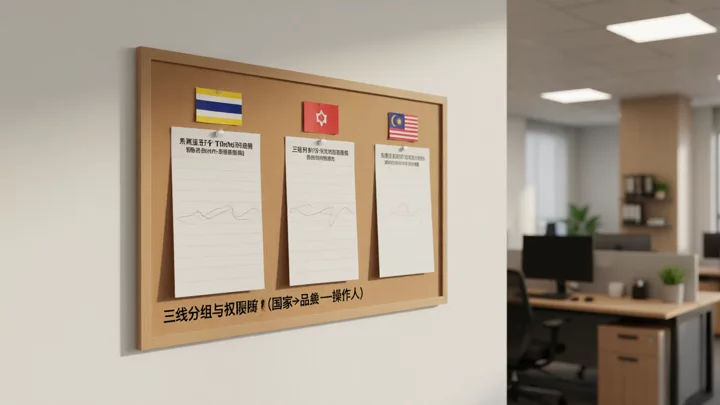
After scaling from 2 stores to 5, the most error-prone area is not sales volume but logins: switching between back-end panels in the same browser, team members sharing the main account, and no audit trail when personnel change. Group stores by the three-tier structure below, then apply the principle of least privilege:
- First Tier (Country Groups):TH group, VN group, MY group. Each group shares the same country-level proxy pool and local payment-receiving channel. Cross-group operations require approval from the group lead.
- Second Tier (Category/Role Sub-groups):Within each group, assign roles by "main store / testing store / clearance store." The main store handles brand and traffic; the testing store runs 2-3 new products; the clearance store processes returns and low-margin SKUs. The role determines which back-end modules a sub-account can access.
- The Third Layer (Operator Binding):Each Profile is fixed to 1 operator; switching operators requires logging the handoff time. Sub-account permission fields are allocated by role: product editing (operations), order viewing (customer service), ad management (advertiser), financial withdrawals (lead only). The main account password must not be included in any team-shared document.
For team collaboration permissions on the TikTok advertising side, it is recommended to manage them through theBusiness Center Roles & Permissionsframework to avoid sharing login credentials. For specific role assignments and handoff procedures, refer toenvironment isolation and permission allocation for teams managing multiple TikTok Shop accounts.
Second-Review Trigger Points and Environment-Side Responses to Ad Account Restrictions
When a local store receives a second-review request, the platform notification typically reads "Documentation Review Not Passed" or "Additional Verification Required," but the actual trigger is often hidden in multi-store operation history and environment configuration. The following 3 high-frequency trigger points are listed in order of self-check priority:
① Documentation Review Not Passed / Legal Representative Verification Failed.The license address does not match the platform entry, legal representative credentials have expired, or the video face-to-face verification deadline was missed. Remediation: resubmit within 48 hours; any address change requires a synchronized update to the scanned license copy.
② Ad Account Restricted Due to Association.Multiple store ad accounts under the same Business Center share a common funding entity. If a store triggers a violation (e.g., the creator-invitation single-store binding rule is breached), associated accounts may be restricted simultaneously. Verification path:TikTok Business Center Assets pageto review account status and restriction reasons. Advertiser conduct must comply withTikTok Advertiser Account Policy, and the review process must not be bypassed.
③ Residual cross-store operation traces.Within the same Profile, operating Store A and then Store B sequentially may cause Store A's violation records to be transmitted to Store B via Cookies and operation logs, triggering cascading verification. This item is directly related to the environment configuration described above; the fix is to re-isolate the Profile and clear residual data.
Frequently Asked Questions
How many TikTok Shop local stores can be opened with a single business license?
For Southeast Asian local stores, 1 local license typically corresponds to 1-3 stores; the specific cap varies by country (Thailand and Vietnam are stricter, while Malaysia is slightly more lenient). Exceeding the cap requires registering a new legal entity. Cross-border stores use Chinese licenses, with more relaxed quantity limits but subject to the platform's phased policies—the prompts displayed in the backend at the time of registration shall prevail.
How many proxy setups are required to run 5 TikTok Shop stores on a single computer?
The minimum configuration is 1 dedicated residential proxy per Profile (5 in total), and the same proxy must not be reused across Profiles within 72 hours. If the 5 stores belong to different countries (e.g., TH×2, VN×2, MY×1), the proxy's outbound IP must match the corresponding country and cannot be mixed. The number of concurrently active Profiles must not exceed 6; additional physical machines are required beyond that.
How long does it take to resume normal order acceptance after a TikTok Shop secondary review?
For document-related secondary reviews (address, legal representative verification), re-review is passed within 2-5 business days after supplementary documents are submitted. For logistics violation secondary reviews, a 14-day SPS recovery observation period is required, during which new orders are processed normally but major sale registrations (including Black Friday) are suspended. If AHR is below 150, a 14-day period is still required after the fix to re-qualify for major sale registrations.
Can local stores and cross-border stores share a single corporate bank account for receiving payments?
It is not recommended. Local stores require a local bank or licensed payment institution account, and under the 2026 new regulations, fund accounts must correspond one-to-one with stores. Sharing an account creates cross-store fund association signals that will be flagged during secondary reviews or ad account audits. Configure an independent payment channel for each store, and assign financial withdrawal permissions only to the responsible party's sub-account.